


Looking to track and get a comprehensive overview of all your sales and profits in Shopify? Reaktion is built precisely for this, and it works in real-time! Managing multiple stores? No problem! Reaktion allows you to view sales across all your Shopify stores, deep dive into specific markets or brands, and analyze sales for any given period. Plus, Reaktion pulls up to two years of historical data, enabling you to compare year-over-year sales. With a perfect 5.00 rating on the Shopify App Store, Reaktion is a top-rated sales and marketing tracker. Install the app from the Shopify App Store today and start tracking your sales within just two minutes!
The Best Shopify Tracking for Sales and Orders
- P&L Analysis
- Track profits of each orders
- Multi-store support (high-level and deep-dive)
- Track shipping & payment fees.
- Track Cost of Goods Sold (COGS)
- Track 37% more orders in Google Ads and Meta Ads with Reaktion’s unique serverside tracking
- Track the true profit, CAC, return rates of all your channels, campaigns, ad sets and ads – and even keywords and products on Google Shopping Ads.
- Plug&play solution. No coding skills required. Setup time is 2 – 3 minutes for both Google Ads and Meta Ads.
What are your current aspirations for your stores? Shopify sales tracking could help you identify products that sell fast or slow, detect problems with checkout, and, most importantly, give you a clear picture of your overall business or marketing performance and growth potential.
Whether you’re a new Shopify entrepreneur, a seasoned e-commerce veteran, or a digital marketing agency, mastering sales tracking and the tools needed to implement them can be the difference between merely staying afloat and achieving remarkable growth for your business.
What is a Shopify Sales Tracker?
Shopify sales trackers are software designed to help you monitor and customize your store’s sales data. They come in various forms — web and mobile apps, extensions, or APIs.
Shopify itself offers built-in e-commerce sales tracking tools through Shopify Analytics. This tool lets you track your store’s sales performance, view reports, and analyze customer behavior.
However, you may need specialized, third-party e-commerce sales trackers for more advanced features, such as:
- Multi-touch attribution analysis
- Extraordinary e-commerce report templates
- Cross-channel performance tracking
- Obtaining specific competitor insights, such as product range comparisons and apps installed by stores like you
Regarding sales reports, Reaktion offers six e-commerce reports that allow you to analyze performance, such as monthly/weekly/daily breakdowns, financial statements, country performance, discount code analysis, expenses, and live order tracking.
4 Metrics You Can’t Afford to Ignore In Shopify Sales Trackers
Your choice of sales metrics to monitor may vary based on your specific goals and strategies.
And, of course, the sales tracking tools you use could influence which metrics you prioritize and how easily you can gather and analyze the data.
In any case, here are common e-commerce metrics that you will need to track.
Sales Conversion Rate (SCR)
Sales conversion rate measures the percentage of web visitors who make a purchase.
A good sales tracker will show the number of web visitors who pass through each stage of the conversion funnel: product page, add to cart, checkout page, and purchase confirmation page.
To calculate your conversion rate, divide the number of conversions by the total number of website visitors.
Average Order Value (AOV)
Average order value measures the average amount customers spend per transaction. You need this metric to assess your pricing strategy and customer purchasing behavior.
For instance, if your AOV is lower than projected, it might indicate that customers are not adding high-value items to their carts or that your product mix isn’t encouraging larger purchases.
To calculate your average order value, you have to divide your total revenue by the number of orders.
Customer Lifetime Value (CLV)
Customer lifetime value measures the time a customer remains with your business.
It involves calculating the purchase frequency, average purchase value, and purchase retention rate.
A good sales tracker provides a CLV calculator for analyzing historical purchase data, predicting future buying behavior, and estimating customers’ long-term value.
Customer Acquisition Costs (CAC)
Customer acquisition costs measure how much it costs to get a new customer through your marketing efforts.
A comprehensive sales tracker should include a marketing attribution tool to break down CAC by marketing channel (e.g., social media, email, paid search). This is required to identify which channels are most cost-effective.
It should also track CAC over time to show trends and the impact of different marketing strategies or digital campaigns.
Other standard metrics to track are:
- Gross sales
- Gross profit
- Net Revenue
- Ad Spend
- Return on Ad Spend (ROAS)
- Click-through rate (CTR)
Further Reading: Explanation of all metrics and KPIs used in Reaktion dashboards and reports
What is Shopify Store Revenue Checker
Shopify Store Revenue Checker is a tool for generating a report of your competitor’s revenue.
Some sales trackers offering this feature comprehensively analyze your competitors’ products, pricing, and typical sales volumes.
Others may even further estimate your competitors’ overall revenue and profitability across multiple stores.
Managing Multiple Stores in Shopify Sales Tracking
Managing multiple Shopify stores within a sales tracking system means monitoring and analyzing the performance of various online stores under a single umbrella.
It involves comparing metrics such as sales volume, ROAS, and inventory turnover for each store.
Store owners’ most significant challenge in managing multiple stores lies in consolidating data and gaining a holistic view of their overall performance. These challenges can manifest as:
Data fragmentation: Fragmented data across different stores makes it difficult to understand and provide actionable insights into sales, marketing, and customer information.
Inefficient reporting: Inefficient reporting, as compiling data from multiple sources can be time-consuming and error-prone.
Campaign attribution: Lack of visibility into trends, opportunities, and issues across the entire e-commerce operation.
Solutions for Multi-Store Management
To address these challenges, you can leverage specialized platforms (such as Reaktion) designed to manage multiple Shopify stores. In particular, Reaktion provides capabilities that make moving the needle in your online sales easier. This includes:
Unlimited Store Integration: The ability to seamlessly connect and consolidate data from any number of Shopify stores into a centralized platform.
Unified Reporting: Linking marketing accounts (e.g., Facebook Ads, Google Ads) to individual or multiple Shopify stores. This enables store-specific reporting and provides a consolidated view of performance as well.
Campaign Allocation: Advanced features for filtering and allocating marketing campaigns (e.g., a consolidated Facebook Ads account/campaign/ad set running ads across various countries) to the appropriate Shopify store. This ensures a holistic understanding of how marketing efforts impact sales.
Data Unification: Integrating e-commerce and marketing data into a single source of truth, empowering data-driven decision-making and optimizing multi-store operations.
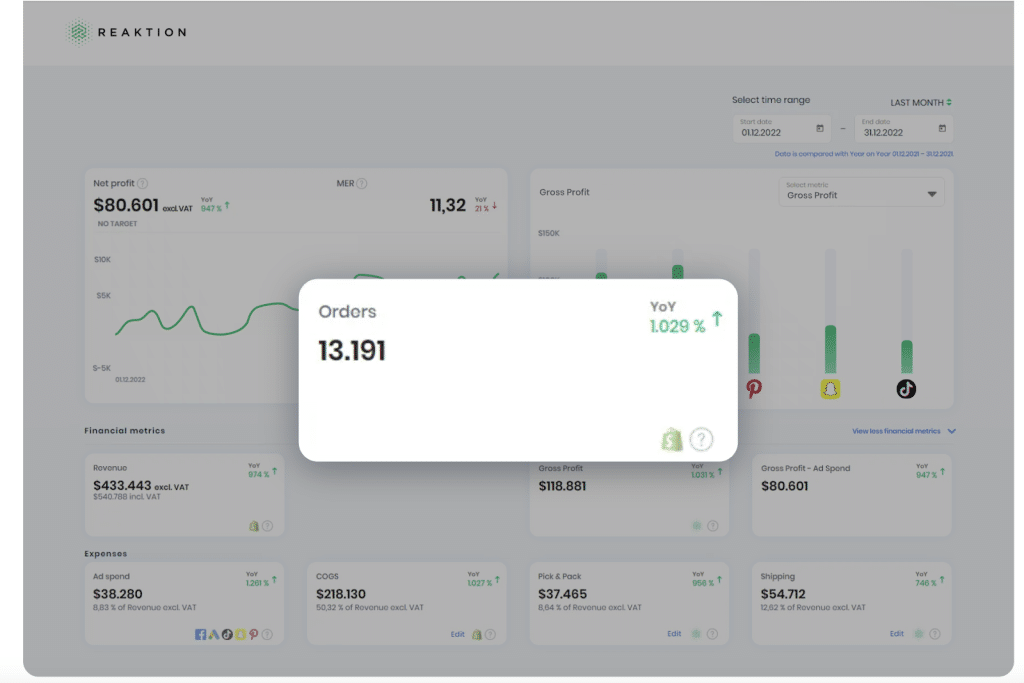
Comprehensive Profit Tracking: Beyond tracking sales, Reaktion also monitors the profitability of each sale by considering factors such as product costs, shipping expenses, payment fees, pick and packaging costs, and returns/refunds.
Frequently Asked Questions (FAQ)
What features should I look for in a Shopify sales tracker?
That depends on your business needs. But the bare minimum is that a Shopify sales tracker should offer multi-store support, server-side tracking, and multi-touch attribution models.
What are the built-in sales tracking features offered by Shopify?
Shopify offers sales reports, customer analytics, marketing analytics, and inventory management tools.
In what ways does Reaktion improve upon traditional Shopify sales tracking?
Reaktion offers a unique combination of features beyond traditional Shopify sales tracking. We provide comprehensive profit tracking, multi-store support, server-side tracking, and advanced marketing attribution that allow you to better understand your business’s performance and optimize your marketing efforts.
Q: How can Reaktion help me improve my marketing ROI?
With our advanced marketing attribution tool, you can identify which marketing channels (e.g., Google Ads, Meta Ads, email) drive the most sales. This allows you to allocate your marketing budget more effectively and maximize your ROAS
Q: Can I use Reaktion to manage multiple Shopify stores?
Absolutely! Reaktion is designed to handle multiple Shopify stores seamlessly. You can track the performance of each store individually or get a consolidated view of your entire business.
Q: How does Reaktion help me track my Shopify store’s profitability?
Unlike many other sales trackers, Reaktion calculates your actual profit beyond order value. We take into account your product costs, shipping fees, payment fees, pick and packaging expenses, and returns/refunds to provide a comprehensive financial picture.
Q: How does server-side tracking benefit my Shopify store?
Server-side tracking ensures you capture 100% of your sales data, even if customers use ad blockers or privacy settings. This provides a more accurate and reliable picture of your store’s performance.


